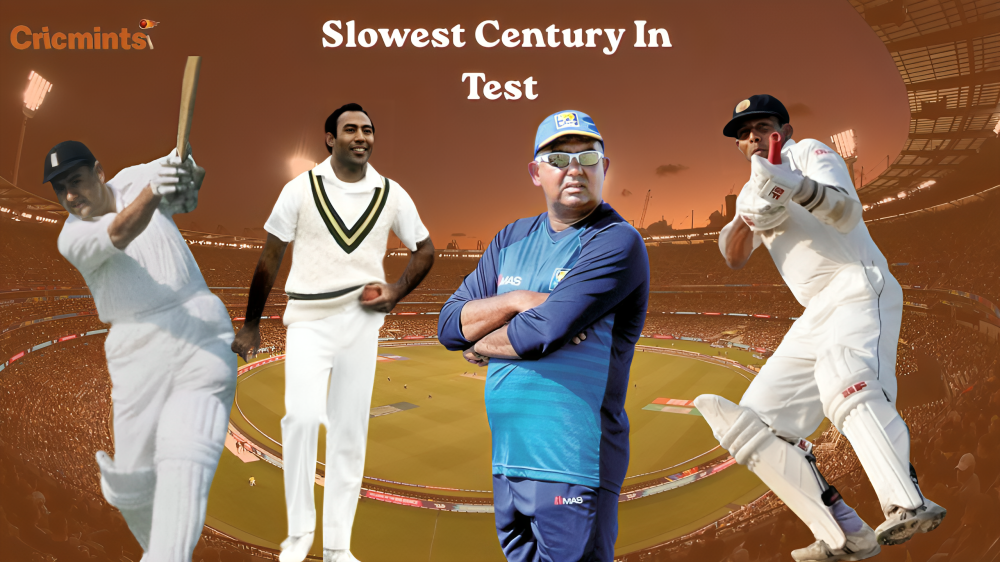
Slowest Century in Test Cricket: Top 13 Most Patient Hundreds in History
Test cricket is sometimes said to be a requirement of skill, patience and mental strength. The slowest century in test is different from limited overs cricket, where good batsmen will take the wicket of bowlers in short numbers of deliveries; a batsman in Test cricket must be able to survive in the form of brutal bowling for a long time. This unique characteristic makes some innings memorable for their slow pace and determination, rather than simply being for their speed. Of many fascinating records in cricket history, the slowest century is one such record.
In Test cricket, 100 is an accomplishment that often comes with amemorable ten run scorecome that includes boundaries. At times, though, extreme care will be required. A batsman in a difficult situation or with great pressure may decide to defend rather than attack. The compelling result has seen several legendary players deliver centuries on an unusually high number of deliveries. These innings might seem sluggish, but they epitomise discipline, concentration and perfectionism.
What Makes the Slowest Century in Test Cricket Special
However, when talking about the list it’s crucial to understand why the slowest century in Test cricket can be of value. The pitch is so bad to hit on many occasions. Bowlers prevail, and it’s tough for the teams to make it until the end without getting bowled out.
Even a patient innings can help to solidify a team. A batsman who sits at the crease for hours for the same time hating the bowler and changing the pace of the game. In addition, they are an effective buffer between a disaster for the team and a collapse.
Furthermore, slow centuries are characterised by outstanding brain power. A player has to maintain his concentration for hundreds of balls and deceleration clear opponents of world-class standard. It would be fair to say that even minor errors of judgement could mean the difference between career blockage and promotion. For this reason, these centuries, notwithstanding their small strike rate, merit honour.
Top 13 Slowest Centuries in Test Cricket History
Below is a table showing the players who recorded the slowest century in Test cricket based on balls faced.
| Rank | Player | Country | Opponent | Year | Balls for 100 |
| 1 | Michael Cowdrey | England | West Indies | 1957 | 535 |
| 2 | Nazar Mohammad | Pakistan | India | 1952 | 520 |
| 3 | Derrick McGlew | South Africa | Australia | 1958 | 485 |
| 4 | Albert Watkins | England | India | 1951 | 480 |
| 5 | Hanif Mohammad | Pakistan | England | 1962 | 448 |
| 6 | Peter Richardson | England | South Africa | 1956 | 440 |
| 7 | Mudassar Nazar | Pakistan | England | 1977 | 419 |
| 8 | Hanif Mohammad | Pakistan | England | 1962 | 410 |
| 9 | Thilan Samaraweera | Sri Lanka | England | 2003 | 408 |
| 10 | Asanka Gurusinha | Sri Lanka | Zimbabwe | 1994 | 405 |
| 11 | John Wright | New Zealand | India | 1981 | 399 |
| 12 | Clive Radley | England | New Zealand | 1978 | 396 |
| 13 | Jimmy Adams | West Indies | Zimbabwe | 2000 | 365 |
These innings represent some of the most patient performances ever recorded in Test cricket.
Michael Cowdrey – The Slowest Century in Test Cricket History
Michael Cowdrey of England is the England record holder for the slowest century in Test cricket. When he went 100 against West Indies in Birmingham during the test series against him in 1957, he was pitched over the amazing 535 balls. There was hardly any support on the field for batting and the West Indies bowlers remained relentless.
Cowdrey responded in a remarkable tolerant manner. He halted just over seven hours, incrementally gathering his hours on the crease. Scoring was very light throughout but his innings helped to stop England from collapsing. This knock will thus be one of the greatest of endurance in the history of Test cricket.
Nazar Mohammad’s Historic Knock
Once again in 1952, Pakistan’s Nazar Mohammad, took another magnificent defensive innings against India in Lucknow. His century was the second slowest in Test cricket after facing 520 off the delivery of a 100 not out. Nazar was very focused in the entire game.
It is notable, however, that this innings played a significant part in Pakistan’s first-ever success in guarding his incapacity after independence. He extended the scoring window for long periods, enabling Pakistan to have a comfortable position in the battle. His unbeaten 124 runs were an emblem of perseverance and strategy for Pakistan cricket history.
Derrick McGlew’s Patient Masterclass
South African batsman Derrick McGlew was known for his extremely cautious batting style. He scored a century against Australia in Durban, using 485 balls, in 1958. This was one of the most iconic slow deliveries of all time in the sport.
Throughout the match McGlew was extremely disciplined. He concentrated on defense, rather than an aggressive attack, to preserve his knapsack. Consequently, his knocks helped South Africa to neutralise Australia’s powerful bowling attack and clinch a draw. He’s still one of the most amazing defensive batters of all time.
Albert Watkins and His Defensive Century
One of the first entries on the slowest century in Test cricket list was by Albert Watkins. In 1951 in Delhi he had to face India and had to go through 480 balls to reach his 100. The turn of the ball made it very tough for the batsmen and bowlers had a field day during the match.
Taking a defensive stance is how Watkins played. Watched deliveries closely and waited patiently with his attention for any scoring chances. His two-res aniversario added to the frustration of the Indian bowlers and went on to keep England in the game. His technique and patience won him great respect, although he was not expected to score as quickly.
Hanif Mohammad’s Legendary Patience
The “Little Master,” Hanif Mohammad made two cuts in the list of slowest century in Test cricket. Amidst the 448 deliveries that he saw against England in 1962, in a Test match at Dhaka, he first went a century.
What makes this feat even more amazing is that he had a second slow century in the same match. He jumped to a score of 100 in the second innings after taking 410 deliveries. This has been a very rare feat, a testament to his immense focus and defensive skill. Cricket’s fittest among the rebels are interested in the freest flow.Cricket’s hardiest batsmen is all about the freedom of play.
Peter Richardson’s Strategic Innings
To hit 440 deliveries to dismiss South Africa, Peter Richardson needed 100 runs in 1956 for the answer in Johannesburg. There was a great deal of pressure in the match, and England needed a stability in the batting line-up.
Richardson played modestly and demurely. He took no reckless chances and slowly developed his batting and just wore the bowlers out.” He was thus instrumental in keeping England in check in the match to put his team 100 points ahead. The tournament of this sort make the concept of patience a potent tool for Test cricket.
Mudassar Nazar’s Record for Longest Time
Mudassar Nazar played one of the best defensive knocks in cricket history. In 1977 he played in Lahore against England and had to take 419 balls to make his 100. But the most remarkable is the time he spent at the crease.
Nazar batted for 557 minutes, which is over nine hours. This made his hundred the rudest from a time perspective. He was able to put his plan into action; the English bowlers went out of breath which meant Pakistan built up a decent total. After some time, Pakistan managed to emerge victorious with ease.
Thilan Samaraweera’s Calm Century
The talented Sri Lankan batsman Thilan Samaraweera also has the distinction of being in the slowest century in Test cricket list. He scored a century (408 balls) against England in 2003.
Samaraweera was mostly partnered with Mahela Jayawardene who they jointly wielded the ball to dominate the game without being aggressive. His composed firing was key to Sri Lanka’s successful effort and successful outcome. It was a man-made innings that exemplified a foray into controlled batting.
Other Notable Slow Centuries
There are a few others with a very poor record of slow hundred wickets in test cricket. In 1994, Asanka Gutuvilakone scored a century (405) in his debut for Sri Lanka against Zimbabwe. In the same manner John Wright hit for the hundred in 399 balls against Indians in 1981.
396-ball century-victory against New Zealand in 1978 by Clive Radley also made the list. Meanwhile, West Indies captain Jimmy Adams rounded off the list with his 365-ball century, against Zimbabwe, in 2000. All of these innings demonstrate the value and discipline of playing the longest game.
Key Insights From the Slowest Century in Test Cricket
One thing is for sure: Michael Cowdrey’s 535-ball innings of play is the slowest century ever. Mudassar Nazar’s 100-year-long run is second to no player in the world. The third one is also that Hanif Mohammad is the only player to record over 400 balls for two centuries in the same Test match.
Additionally, many of the classic Test batsmen often played very astute Test innings. Geoffrey Boycott, Leonard Hutton and other players have often played over 300 balls to reach their century.
Why Slow Centuries Are Rare Today
Things have changed, and drastically, in Test cricket. Players today tend to play aggressively, inspired by the L.O game. That has led to improvements in scoring rates in every format.
But there are times when patience is crucial. Batsmen need to be prudent and play slowly with a careful approach on rough corners or in crucial situations. The essence of the slowest century in Test cricket is still there today, and the modern age should serve to remind cricketers that endurance is an important part of their game.
Final Thought On Slowest Century in Test Cricket History
It’s about the slowest of centuries in Test cricket, and the stories lie behind it. These balls reflect bravery, perseverance and a supreme attention to detail. While they may not be known for their pace, they prove themselves mentally tough to compete in Test cricket.
It was about the spirit overcoming the hard bowling that was proved by players such as Michael Cowdrey, Nazar Mohammad and Hanif Mohammad. They still represent classic exemplifications of defence. These slow centuries have also helped remind players in a high-pressure game that sometimes it’s the patience that can yield the biggest results in the game of cricket.
Read More Cricket News: