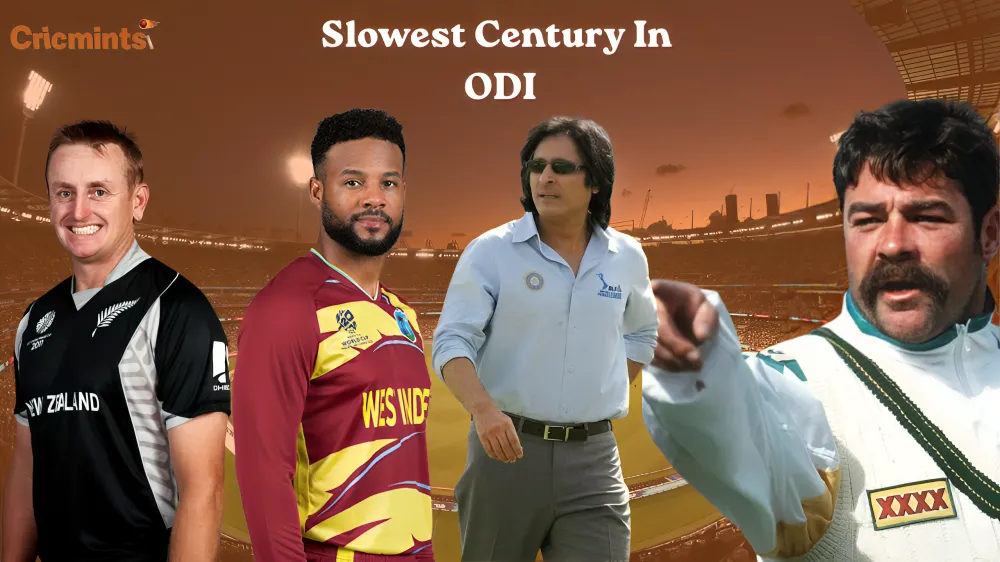
Slowest Century in ODI: Top 10 Slowest Hundreds Ever
Massive transformations in cricket over the years. The contemporary one-day matches are characterized by attacking batting, huge ranges of sixes, rapid centuries, and strike rates of more than 120. This has taken fans demanding entertainment out of each batter. A bad inning is the one that receives constructive criticism on social media. Nevertheless, at some point, ODI cricket had quite a different appearance. Batters did more on survival, patience, and formation of partnerships cautiously. This is the reason why the subject of the slowest century in ODI has continued to be a fascinating theme among the lovers of the sport worldwide.
The century is not necessarily poor batting. A lot of these innings were in challenging match situations. Other players had to endure the unsafe bowling of slow pitches. Others attempted to rescue their innings once weighted down early. These knocks contributed to the winning of critical matches of teams in most instances, even though the scoring rate was slow.
The ODI cricket history has been associated with a number of patient innings that not only put the patience of fans at test but also gave an indication of the mental abilities of batters. There were no flashy shots in constructing these centuries. Instead, they arrived via quiet batting, clever strike rotation, and lengthy time in the crease.
We are going to look at the details of all of the major records connected with the slowest century ever in the history of ODI, best innings by the great players, causative factors of slowness in batting, situations in a match, strategies of players, the comparison with modern-day cricket, and a lot more in this described article.
Understanding the Concept of Slow Centuries in ODI Cricket
ODI cricket typically favors aggressive batwork. The teams consistently score more than 300 runs due to the existence of improved batting conditions, shorter boundaries, and aggressive attitudes. But the previous generations of cricketers had a different attitude toward ODI cricket.
Batters were concerned about:
- Preserving wickets
- Building partnerships
- Pitch-based playing.
- Reducing risks
- Taking singles regularly
The effect was faster centuries ago. It would require over 140 or even 150 balls to get 100 runs in many innings. These knocks could sound agonizingly slow in our time, yet in their time, they were thought-wise and conscientious hits.
The argument about the last century being the slowest in ODI is of interest as it demonstrates the extent to which the game has been changing over time.
Complete List of the Slowest Century in ODI History
The following table throws emphasis on the most snail-paced ODI centuries in terms of the number of balls required to finish the hundred.
| Rank | Player | Balls for Century | Opponent | Year |
| 1 | David Boon | 166 | India | 1991 |
| 2 | Rameez Raja | 157 | West Indies | 1992 |
| 3 | Geoff Marsh | 156 | England | 1989 |
| 4 | Rameez Raja | 152 | Sri Lanka | 1990 |
| 5 | Scott Styris | 152 | Sri Lanka | 2007 |
| 6 | Tom Cooper | 151 | Afghanistan | 2010 |
| 7 | Geoff Marsh | 150 | West Indies | 1991 |
| 8 | David Hemp | 150 | Kenya | 2009 |
| 9 | Shai Hope | 149 | India | 2019 |
| 10 | David Boon | 146 | West Indies | 1992 |
This table is a clear reflection of how, in previous decades, batting style in ODI was very slow.
David Boon and the Slowest Century in ODI Cricket
The slowest century in ODI is held by David Boon. The 1991 innings of India are one of the slowest hundreds in international cricket history.
The innings might be hard to understand at first for modern-day cricket enthusiasts. But it is easy to see after a certain examination as to why Boon did so.
Australia is moderately targeted. Rather than engaging in unneeded risks, Boon concentrated on ensuring that it was not beaten until the very end. He gradually gathered runs in the form of singles and rare limits.
Match Details of David Boon’s Record Century
| Match Information | Details |
| Venue | Hobart |
| Opponent | India |
| Year | 1991 |
| Balls for Hundred | 166 |
| Final Score | 102* |
| Boundaries | 8 fours |
| Strike Rate | 60.71 |
The innings took almost three hours. Boon was quiet in pursuit. He did not believe in attacking cricket but in traditional ODI batting.
Why This Innings Became Historic?
There are a few ways as to why this innings is still talked about today:
- It was and still is the slowest ODI century.
- Australia was able to pursue the target.
- Boon was mind-blowingly focused.
- The game was typical ODI cricket.
Although the innings was not entertaining, it was very appropriate to the situation of the match.
Rameez Raja’s Extremely Slow World Cup Hundred
The list of slowest ODI centuries has Rameez Raja twice. The most renowned slow innings was the one he had in the 1992 Cricket World Cup against the West Indies.
Pakistan batted first in the match. Raja began the innings cautiously, criticizing as well as concentrating much on defense. He did not take chances and played predominantly grounded cricket.
Performance Summary
| Detail | Information |
| Balls for Century | 157 |
| Final Score | 102 |
| Boundaries | 4 |
| Strike Rate | 64.55 |
| Match Result | Pakistan Lost |
The duration of the innings was over 180 minutes. Nevertheless, the overall score of Pakistan was still below the average since the number of points did not grow during the innings.
Lessons From Raja’s Knock
This inning has a number of valuable lessons in cricket:
- It is not sufficient to hold on to the crease.
- The rate of running is very important in ODI.
- Alliances have to be prudent and tough.
- Situations at the match determine the pace of batting.
Raja was very patient and controlled defensively though Pakistan lost finally.
Geoff Marsh and the Art of Traditional ODI Batting
In the context of old-school ODI cricket, one player should be specifically mentioned: Geoff Marsh. On the list of the slowest ODI centuries appear Marsh twice.
He was known for:
- Calm batting
- Safe shot selection
- Long partnerships
- Match awareness
- Responsible for opening batting
Marsh was seldom a wanton cricket player. He was to anchor the innings and stay till the end of the final overs.
Geoff Marsh vs England – A Match-Winning Knock
In 1989, Marsh had one of the slowest but most productive centuries in an ODI against England.
| Match Stats | Details |
| Balls for Century | 156 |
| Final Score | 111* |
| Result | Australia Won |
| Strike Rate | 68.51 |
Australia met the target since Marsh played the innings throughout.
Importance of His Innings
His inning was a significant one:
- Poor batting does not necessarily imply poor effective batting.
Actually, Marsh managed the pursuit very well, and Australia remained ahead of the needed running pace.
Scott Styris Played One of ODI Cricket’s Best Rescue Innings
The number of innings that Scott Styris played in the 2007 World Cup can be highly respected. However, early in the innings, New Zealand were in dire trouble. Wickets were falling very rapidly, and someone was needed to make the team up again. Styris embraced such responsibility.
Match Situation Faced by Styris
| Situation | Details |
| Team Score Early | 4 wickets for 2 runs |
| Opponent | Sri Lanka |
| Tournament | ICC World Cup 2007 |
| Balls for Century | 152 |
| Final Score | 111* |
Styris did not panic, but made the game slow down and concentrated purely on surviving.
Why Fans Still Remember This Knock?
The innings was remarkable due to:
- The New Zealanders were going down.
- Styris could be depended on in times of pressure.
- He bore the innings to a great extent.
- It was a hundred years, a World Cup.
However, when New Zealand lost in the end, Styris could enjoy the attention of international experts in the domain of cricket.
Shai Hope Proved Slow ODI Hundreds Still Work Today
In current-day ODI cricket, there is a preference towards aggressive batting. But as Shai Hope demonstrated in 2019, patience may still be able to succeed.
In Chennai against India, Hope made a measured innings as part of a tricky pursuit. The latter did not want to take risks in batting and built up the union gradually.
Shai Hope’s Important ODI Century
| Match Detail | Information |
| Opponent | India |
| Year | 2019 |
| Balls for Century | 149 |
| Final Score | 102* |
| Match Result | West Indies Won |
Hope made quite a few surprised fans with his innings since this kind of slowness in batting is no longer common in ODI cricket.
Why His Innings Was Successful?
Hope succeeded because:
- He trotted the innings smart.
- He did not like undue pressure.
- He rolled strike in and out.
- He trusted partnerships
This knock confirmed that even the ODI cricket in modern-day has not left traditional ways of batting.
Why Did Slow ODI Centuries Happened More Frequently Earlier?
The previous ODI cricket was far different from that of the modern day. There are a number of reasons that led to slower batting in the past decades.
Main Reasons Behind Slower ODI Batting
1. Difficult Pitch Conditions:- The bowlers were commonly assisted by old pitches. Playing on unstable surfaces was dangerous.
2. Improved Bowling Conditions Swings.:- Only a white ball was used previously by cricketers. Sustained effects of reverse swing and seam movement were also effective.
3. Conservative Team Strategies:- Safe cricket was favored by teams over aggressive batting.
4. Bigger Grounds:- The size of the boundaries was bigger than contemporary stadiums.
5. Stronger Bowling Dominance:- Matches were controlled by fast bowlers and spinners more.
They all made defensive centuries and slow innings a natural.
Conclusion
It is not just a tale of slow scoring that the last century was the slowest one ever in ODI history. It is tact, focus, brio, and traditional cricket tactics. Slow-paced batting by players such as David Boon, Geoff Marsh, Rameez Raja, and Shai Hope demonstrated that the players could assist the teams in challenging circumstances.
Although this kind of patient century has lost its relevance in modern ODI cricket, where explosive batting is seen as the norm, such centuries still have a historical context. They serve to remind the fans of the game that not everything in the game of cricket is speed. Survival and control are more significant at times than amusement.
The lowest century in ODI record might sound odd in the modern fast-paced world of cricket, but it still is one of the most interesting records in the history of ODI.
Read More Cricket News: