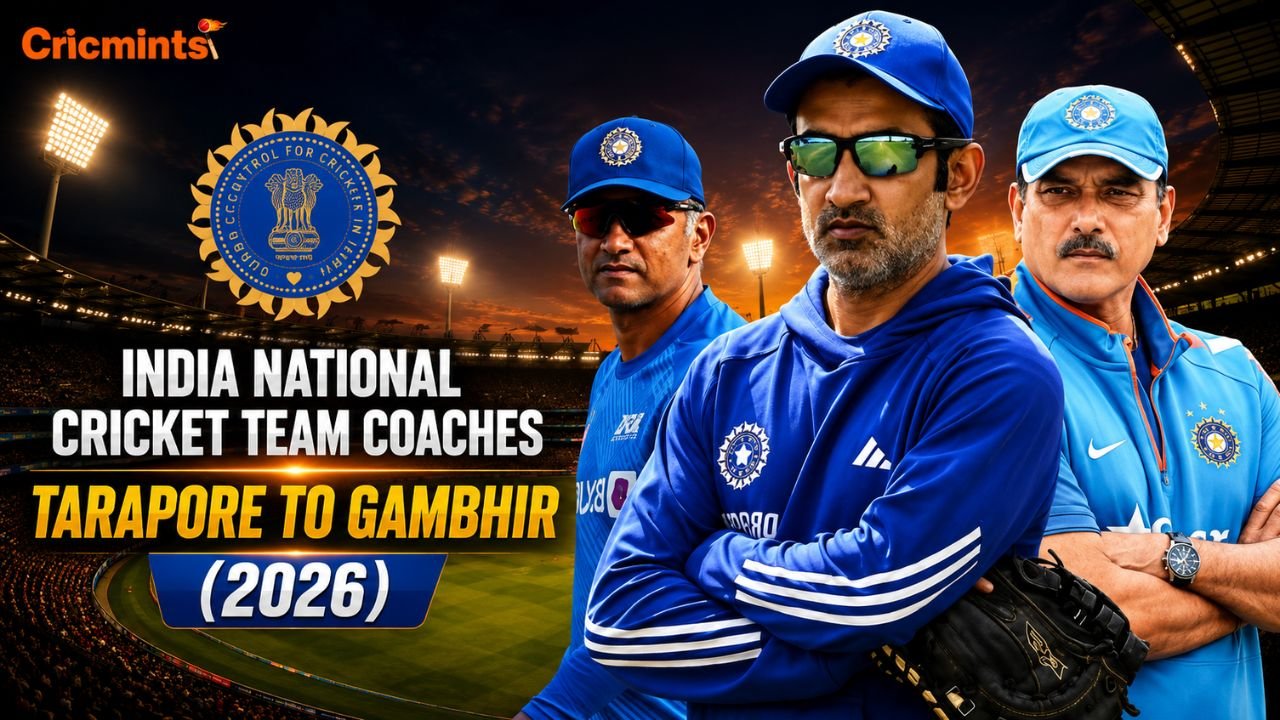
India National Cricket Team Coaches: Tarapore to Gambhir (2026)
India national cricket team coaches carry a job that goes far beyond picking eleven players and setting a batting order. Every decision they make gets analyzed by millions of fans, debated on television, and questioned after every series. Right now, Gautam Gambhir holds this position, and his tenure has already produced three ICC trophies alongside two surprising home Test series losses.
This article breaks down who currently manages Team India, how the coaching setup actually works behind the scenes, and how the role transformed over five decades. Real trophy records, staff structures, and historical context show exactly why this position matters so much to Indian cricket’s future.
Gautam Gambhir Leads India’s Coaching Setup in 2026
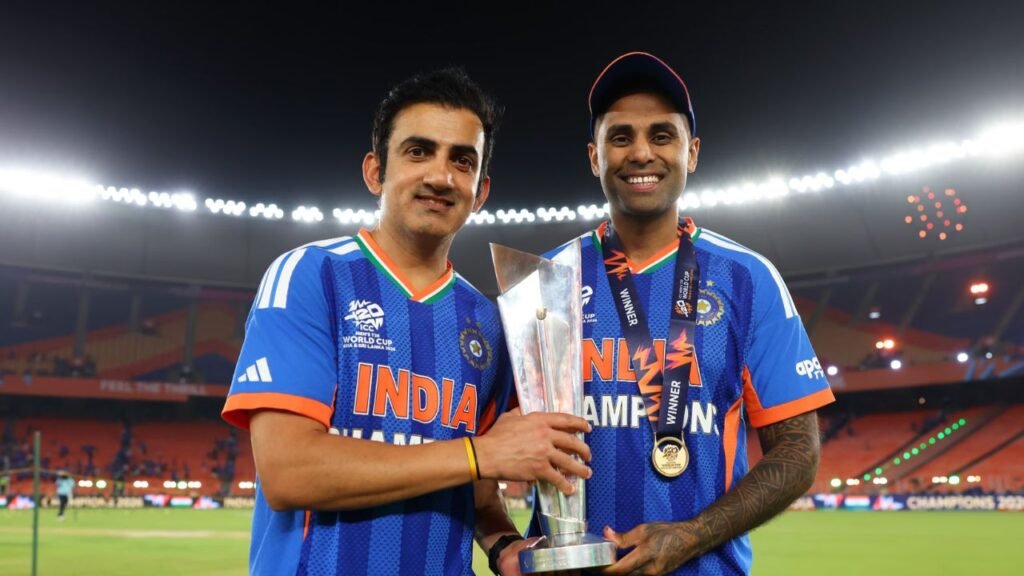
Gautam Gambhir currently holds the top coaching job for the Indian men’s team. He was appointed in July 2024, taking over right after Rahul Dravid’s departure following India’s T20 World Cup win. His arrival brought a sharper, more direct coaching tone that players quickly noticed during early team meetings.
Gambhir focuses heavily on match-ups instead of generic preparation. He wants every batter and bowler to know their exact job in a specific match phase, so nobody scrambles for a plan mid-innings. This clarity, in turn, reduces hesitation during high-pressure overs, which used to cost India crucial moments in the past.
Selectors under Gambhir also lean toward specialists rather than flexible all-rounders who “adjust on the day.” That shift reflects real confidence in preparation, and it shows how far Indian cricket has moved from relying purely on natural talent.
Head Coach and Specialist Staff Roles
Team India’s coaching panel today functions through clearly divided responsibilities rather than one person overseeing everything alone.
| Role | Name | Focus Area |
| Head Coach | Gautam Gambhir | Strategic multi-format planning |
| Assistant Coach | Abhishek Nayar | Structural player rehabilitation, target nets, situational batting simulations |
| Assistant/Batting Advisor | Ryan ten Doeschate | Field adaptability, middle-overs tactical flexibility |
| Bowling Coach | Morne Morkel | Elite pace pipeline, wobble seam execution, death-overs variations |
| Spin Bowling Coach | Sairaj Bahutule | Spin variations, countering subcontinental batting collapses |
| Fielding Coach | T. Dilip | Blind-angle catching, direct-hit scenario drills |
Ten Doeschate’s role currently faces internal review because of heavy travel demands, showing how physically taxing these support positions have become for modern coaching staff.
Interim and Shadow Tour Arrangements
India’s calendar rarely gives one coach a clean run across every series. Because of this, the BCCI relies on a split-coaching model for secondary tours.
- VVS Laxman, head of the National Cricket Academy, steps in as interim head coach whenever fixtures overlap.
- He led the squad for the July 2026 T20I tour of Zimbabwe while Gambhir managed other commitments.
- Laxman also takes charge during the 2026 Asian Games in Japan.
- Sunil Joshi and Hrishikesh Kanitkar support Laxman on these shorter assignments.
This arrangement isn’t new either. Laxman filled a similar gap during Rahul Dravid’s stint, proving that the NCA head now functions almost like a permanent second coaching track rather than a temporary fix.
Read More Latest Cricket News: IPL Commentators’ Salary Revealed: Who Earns the Most?
India Cricket Team Coaches List – Head Coaches of the Indian Men’s Team from 1971 to 2026
India’s cricket coaching journey began in 1971, when a head coach was officially appointed for the first time. Before that, team management was informal, with captains and selectors handling most responsibilities. Over time, the role became more professional, and today it’s one of the most important and high-pressure jobs in world cricket.
Early Era (1971–1990)
This phase was about laying the foundation for Indian cricket. Coaches mainly focused on basic skills, discipline, and developing young players. This era also saw India win its first World Cup (1983), with PR Man Singh and Ashok Mankad playing important roles behind the scenes.
| Coach | Years | Highlights |
| Keki Tarapore | 1971 | India’s first official head coach |
| Hemu Adhikari | 1971–1974 | Led India to their first-ever series win in England |
| Gulabrai Ramchand | 1974–1975 | Coach/manager during the 1975 World Cup |
| Datta Gaekwad | 1975–1978 | Transitional period |
| Ashok Mankad | 1982 | Prepared the side for the 1983 World Cup |
| PR Man Singh | 1983–1987 | Key role in the 1983 World Cup win |
| Chandu Borde | 1988 | Calm, composed leadership |
Transition & Building Phase (1990–2000)
This decade was somewhat unstable in terms of coaching, with several coaches serving short stints. However, this period saw important work on bowling discipline, youth development, and team unity — groundwork that later helped India become a stronger side.
| Coach | Years | Highlights |
| Bishen Singh Bedi | 1990–1991 | Improved bowling discipline |
| Abbas Ali Baig | 1991–1992 | Focused on youth development |
| Ajit Wadekar | 1992–1996 | Strong home series wins |
| Sandeep Patil | 1996 | Brief stint |
| Madan Lal | 1996–1997 | Strengthened all-round performance |
| Anshuman Gaekwad | 1997–1999, 2000 | Built team unity and discipline |
| Kapil Dev | 1999–2000 | Tried energizing team culture |
Modern Coaching Era (2000–2015)
The biggest shift in this era was the arrival of foreign coaches. John Wright became India’s first overseas coach, modernizing the coaching structure. This period also saw India win major titles — the 2007 T20 World Cup, the 2011 ODI World Cup, and the 2013 Champions Trophy.
| Coach | Years | Highlights |
| John Wright | 2000–2005 | First foreign coach; reached the 2003 World Cup final |
| Greg Chappell | 2005–2007 | Introduced young talent |
| Lalchand Rajput | 2007 | Won the 2007 T20 World Cup |
| Gary Kirsten | 2008–2011 | Won the 2011 World Cup |
| Duncan Fletcher | 2011–2015 | Won the 2013 Champions Trophy |
Recent Era (2014–Present)
This has been the most successful and structured phase yet. Ravi Shastri coached India across three separate stints — a record. Under Rahul Dravid, India won the 2024 T20 World Cup, and now under Gautam Gambhir, the team has continued winning ICC titles consistently.
| Coach | Years | Highlights |
| Ravi Shastri | 2014–2016, 2017–2021 | Coached India across three separate stints |
| Anil Kumble | 2016–2017 | Dominant home performances |
| Rahul Dravid | 2021–2024 | Won the 2024 T20 World Cup |
| Gautam Gambhir | 2024–Present | Won the 2025 Champions Trophy and 2026 T20 World Cup — two ICC titles |
Read More Latest Cricket News: India Tour of Zimbabwe 2026: Squads, Dates & Preview
Tracing How India’s Coaching Role Changed Over Time
Today’s multi-specialist coaching model did not appear overnight. Indian cricket’s coaching structure moved through three distinct phases, and each phase reflects how seriously the sport started treating professional team management.
The Early Manager Era (1971-2000)
Before 2000, coaches functioned more like disciplined travel managers than modern strategists focused on data and analytics.
- Keki Tarapore built the earliest systematic preparation routines for the national side.
- Hemu Adhikari introduced strict, army-style fitness discipline decades before it became standard.
- Ajit Wadekar guided India through tactical ODI growth during strong subcontinental campaigns.
- Sandeep Patil brought short-term tactical freedom and aggressive strokeplay to the dressing room.
- Madan Lal focused on raw work ethic during a genuinely difficult transitional phase.
- Anshuman Gaekwad earned praise across two stints for keeping players calm under heavy media scrutiny.
- Kapil Dev bridged old-school dressing room culture with emerging professional structures.
Foreign Coaches: Who Modernized Team Strategy (2000-2015)
All this changed when the BCCI started to employ long-time foreign coaches about 2000. Sports science, systematic drafting and long-term strategy became components of daily workouts.
The first player who came to India was John Wright, who closely worked with Sourav Ganguly and established the fearless identity of the Indian team in away matches, which Indian teams failed to achieve before him. Greg Chappell was next to come with a turbulent, reform-oriented style that preferred youthful talent almost at the expense of senior steadiness, a style that stirred a lot of controversy at the time.
Then Lalchand Rajput led a very young underdog team to the historic T20 World Cup title of 2007, to show that coaching bridges can still bring huge results when the players believe in it.
Gary Kirsten built something entirely different afterward. He made a secure dressing room, player-driven and working in close collaboration with a mental conditioning expert, Paddy Upton, who believed in its gut instincts in stressful situations. This faith rewarded him in the ODI World Cup victory in 2011, and the position of first in the tests, a dual accolade certainly no other India coach has managed to achieve since.
Duncan Fletcher ended this period not noisily but quite successfully, and there was a way of winning the 2013 Champions Trophy on the way.
Present Day Coaches Building An Integrated System (2015-Present)
Today’s coaching setup blends technology, workload management, and domestic pipeline development into one connected structure. Coaches no longer operate separately from the NCA or India A programs.
Ravi Shastri assembled a terrifying fast-bowling attack and won two consecutive series of Test matches in Australia – and that too without any Indian team having been successful in doing so in decades. Anil Kumble came in with ruthless, fact-based planning when his team was in a great streak of wins at home before he departed prematurely because of thoroughly reported office angst. The pipeline work eventually led to the 2024 T20 World Cup win, and India A, along with the NCA, were more closely tied at that time than they were before by a former coach, Rahul Dravid.
Gambhir has inherited that powerful wave in 2024, and today, he is dealing with a challenging transitory phase that combines an offensive tactical rotation with the strain of enforcing the recently established white-ball hegemony of India.
Trophy Record Comparison Across Modern Head Coaches
Trophy counts alone rarely tell the whole story, but they still offer useful context when comparing different coaching tenures fairly.
Major Titles Won Under Each Head Coach
| Head Coach | Tenure | Major ICC / Multi-Nation Trophies Won | Key Legacy Milestone |
| John Wright | 2000–2005 | 2002 ICC Champions Trophy (Shared) | Finalists of the 2003 ODI World Cup; Redefined away Test resilience. |
| Lalchand Rajput | 2007–2008 | 2007 ICC T20 World Cup | Pioneered India’s modern T20 team identity. |
| Gary Kirsten | 2008–2011 | 2011 ICC ODI World Cup, 2010 Asia Cup | Secured historic World No. 1 Test Ranking. |
| Duncan Fletcher | 2011–2015 | 2013 ICC Champions Trophy | Blooded India’s modern white-ball top-order core. |
| Ravi Shastri | 2017–2021 | 2018 Asia Cup | Back-to-back Test Series victories in Australia (2018/19 & 2020/21). |
| Rahul Dravid | 2021–2024 | 2023 Asia Cup, 2024 ICC T20 World Cup | Maintained undefeated home Test streaks and consecutive WTC Finals. |
| Gautam Gambhir | 2024–Present | 2025 ICC Champions Trophy, 2025 Asia Cup, 2026 ICC T20 World Cup | White-ball Dominance: High win-rate in T20Is. Test Transition Crisis: Suffered rare home Test series losses to New Zealand and South Africa. |
Gambhir’s trophy count already matches coaches who served three or four times longer, yet his home Test losses remind everyone that white-ball success alone rarely settles coaching debates.
Read More Latest Cricket News: Who is the Owner of CSK? CSKCL, Srinivasan & Real Ownership
Why White Ball Success Doesn’t Guarantee Test Match Wins?
Most fans judge a coach purely through trophies, but white-ball cricket and red-ball cricket actually reward completely different coaching instincts. Very few coaches manage both formats equally well throughout their tenure.
Gambhir is an aggressive player whose style has been fulfilling in T20 cricket, as he can make impetuous tactical changes that directly translate into match winning under extreme time constraints. This is why the white-ball shape of India has remained incredibly powerful since 2024. But test cricket, however, requires something of a different sort. It rewards patience, gradual technical correction, and a settled batting order built across several months rather than a few weeks.
India’s home losses to New Zealand and South Africa happened while Gambhir simultaneously managed middle-order transitions alongside his naturally aggressive tactical identity. There is no real questioning of whether Gambhir can coach well or not after all by the ongoing review conducted by BCCI. It rather posits asking whether a single coaching philosophy can be applied to three formats equally, which is a question that all India coaches since Shastri have ultimately had to grapple with.
Mistakes Fans Often Make While Rating Coaches
Fans frequently judge coaches only through ICC trophies while ignoring bilateral Test results, even though those results shape long-term team culture just as strongly.
- Many assume the head coach controls every format equally, though specialist assistants like bowling or spin coaches often influence format-specific outcomes more directly.
- People often overlook how much the NCA pipeline shapes a player’s game long before that player ever meets the senior head coach.
- Comparing coaches across different eras without adjusting for format changes creates unfair conclusions, since T20 cricket didn’t even exist during John Wright’s tenure.
- Fans sometimes blame the head coach for individual player form dips, though technical issues usually fall under specialist coaches instead.
Smarter Ways To Judge A Coach’s Real Impact
Breaking down performance separately by format instead of relying on one blended win percentage gives a much clearer picture of a coach’s actual strengths and weaknesses. This can also be gleaned by watching support staff changes, as an action such as the appointment of Sairaj Bahutule in the middle of 2026 will tell, pretty much precisely, where the team is most frail.
The monitoring of statements made by the Cricket Advisory Committee of BCCI is likely to disclose coaching changes long before any official news is issued. Equally, it is common to trace NCA personnel change fingerprints in the long-term selection philosophy many years before headlines following senior area team decisions.
Future of India’s Coaching Structure (2026-2027)
India’s coaching model appears to divide the job even more as opposed to having one individual in charge. The format-specific assistant coaches will probably have increased power, particularly in Test cricket, because the review conducted by the BCCI clearly indicates concerns about the possibility of implementing the same strategy in all formats.
The contract of Gambhir extends to the 2027 World Cup cycle of ODIs, and it would appear that continuity will take place up until that point unless there is a sudden decline in white-ball fortunes. The growing responsibility of VVS Laxman (Zimbabwe tours to Asian Games duty) is indicative of a BCCI that is slowly developing a second coaching track permanently, as opposed to considering it a temporary solution.
Final Thoughts On India’s Coaching Journey
India national cricket team coaches have shaped this sport far more than casual fans usually realize, moving from Keki Tarapore’s basic frameworks to Gambhir’s data-driven, specialist-heavy setup today. His success with white balls is eloquent, but the white test is a poor show of why this single coaching philosophy is finding it hard to please all the formats at the same time. Whichever way the BCCI chooses to go following its pending structural audit, the next phase of Indian cricket shall greatly rely on a compromise between the T20 instincts which require aggressiveness and the continued patience which the Test version still requires.
Read More Latest Cricket News: Who’s the Owner of GT? Torrent Group, CVC Capital 2026
Frequently Asked Questions
Gautam Gambhir has served as head coach since July 2024.
He took charge in July 2024, right after India’s T20 World Cup win.
John Wright became India’s first full-time overseas coach in 2000.
Morne Morkel serves as India’s bowling coach in 2026.
VVS Laxman, the NCA head, manages interim and shadow tour assignments.
Gambhir has won three major titles within two years of taking charge.
Yes, India defeated New Zealand by 96 runs in the final.
Gary Kirsten led India to the 2011 ODI World Cup title.
The head coach runs main tours while the NCA head manages player pipeline and secondary tours.
Rahul Dravid served as head coach from 2021 until mid-2024.

Post Comment