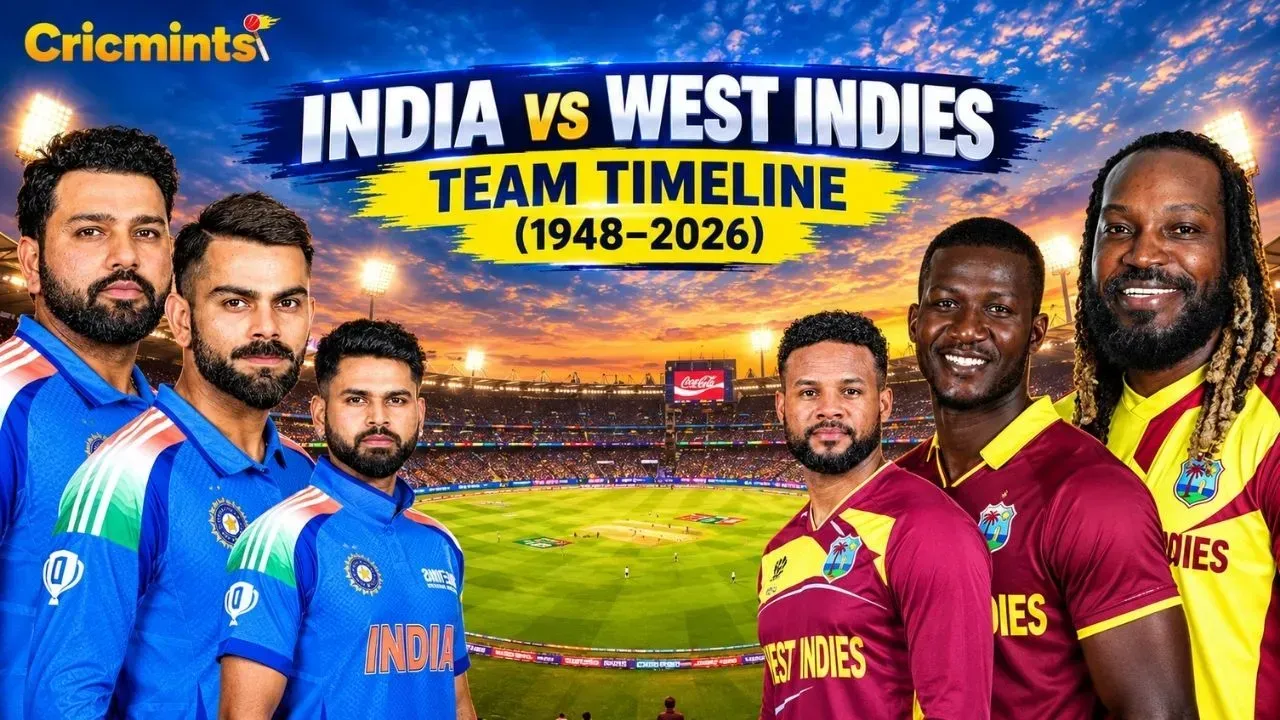
India vs West Indies Cricket Team Timeline (1948–2026)
The India national cricket team vs West Indies cricket team timeline covers nearly eight decades of international cricket, from their first Test match in 1948 to their latest encounters in 2026. The rivalry has featured historic Test series, the 1983 Cricket World Cup final, dramatic T20 World Cup clashes and memorable performances from generations of legendary players.
West Indies enjoyed considerable success during the early decades, particularly with their formidable batting line-ups and fast-bowling attacks. India gradually established themselves as a dominant force, highlighted by their breakthrough Test series victory in the Caribbean in 1971 and their famous World Cup triumph at Lord’s in 1983.
In modern cricket, India have generally enjoyed greater success in bilateral contests, particularly in Tests and ODIs. However, West Indies remain a dangerous opponent in T20 cricket, where their power-hitting and aggressive approach have produced several memorable victories.
India National Cricket Team vs West Indies Cricket Team Timeline: Overview
India and West Indies first met in Test cricket in November 1948. Their first ODI took place during the 1979 Cricket World Cup, while their first T20 International was played at Lord’s in June 2009.
| Detail | Information |
| First Test match | 10 November 1948 |
| First ODI | 9 June 1979 |
| First T20I | 12 June 2009 |
| First Test venue | Feroz Shah Kotla, Delhi |
| First ODI venue | Edgbaston, Birmingham |
| First T20I venue | Lord’s, London |
| Most famous rivalry milestone | 1983 Cricket World Cup final |
| Historic Indian Test breakthrough | 1971 tour of West Indies |
| Latest Test series in the supplied records | October 2025 |
| Latest ODI meeting in the supplied records | 3 October 2026 |
| Latest T20I meeting in the supplied records | 9 October 2026 |
The rivalry has evolved from a contest dominated by West Indies in its early years into a multi-format competition in which India have achieved sustained success. The 1983 World Cup final remains one of its defining moments, when India defeated the defending champions by 43 runs to win their first World Cup title.
India vs West Indies Timeline: Complete History
The following timeline highlights the major series, tournaments and turning points that have shaped the rivalry.
| Year | Format or event | Major moment |
| 1948–49 | Test cricket | West Indies toured India for the first five-Test series between the teams. |
| 1952–53 | Test cricket | India toured the Caribbean for their first Test series against West Indies there. |
| 1958–59 | Test cricket | West Indies won three Tests during their tour of India. |
| 1961–62 | Test cricket | West Indies completed a 5–0 Test series sweep at home. |
| 1970–71 | Test cricket | India secured their first Test series victory in the Caribbean. |
| 1974–75 | Test cricket | India won two home Tests against West Indies. |
| 1979 | ODI cricket | The teams met for the first time in a One Day International at the World Cup. |
| 1983 | Cricket World Cup | India defeated West Indies by 43 runs in the final at Lord’s. |
| 1983–84 | Test cricket | West Indies won three Tests during their tour of India. |
| 1987–88 | Test cricket | India won the Chennai Test by 255 runs. |
| 1994–95 | ODI cricket | India and West Indies played a closely contested series of international matches in India. |
| 2002 | Test and ODI cricket | Both teams recorded significant victories during a busy period of bilateral cricket. |
| 2006 | Test cricket | India won a Test in Jamaica during their Caribbean tour. |
| 2009 | T20I cricket | The teams began their T20 International rivalry at Lord’s. |
| 2011 | ODI cricket | India defeated West Indies by 80 runs at the World Cup. |
| 2013 | ODI cricket | India won both ODIs during West Indies’ visit to India. |
| 2016 | T20 World Cup | West Indies defeated India in the semi-final in Mumbai. |
| 2018 | Test and ODI cricket | India registered emphatic Test victories and won the ODI series 3–1. |
| 2019 | Test cricket | India won both Tests in the Caribbean. |
| 2022 | ODI and T20I cricket | India recorded strong bilateral results in the Caribbean and at home. |
| 2023 | Test, ODI and T20I cricket | India won the Test series and ODI series, while West Indies won the T20I series 3–2. |
| 2025 | Test cricket | India won both Tests in their home series against West Indies. |
| 2026 | ODI cricket | India won the three-match ODI series 2–1. |
| 2026 | T20I cricket | India won the first T20I before West Indies levelled the series in Ranchi. |
The sequence illustrates how the balance has changed over time. West Indies established an early advantage in Test cricket, India emerged as a major challenger during the 1970s and 1980s, and the modern era has seen India become particularly successful in limited-overs cricket.
1948–49: The First India vs West Indies Test Series
The India national cricket team vs West Indies cricket team timeline began with West Indies’ tour of India in 1948–49. The two teams played five Test matches, establishing an international rivalry that would continue across generations.
The opening Test began on 10 November 1948 at Feroz Shah Kotla in Delhi, now known as Arun Jaitley Stadium. The match ended in a draw. The next two Tests, at Brabourne Stadium and Eden Gardens, also ended without a winner.
West Indies then secured a commanding victory in the fourth Test at Madras, winning by an innings and 193 runs. The fifth Test in Bombay was drawn, leaving West Indies with a 1–0 series victory.
This first series reflected the contrasting stages of development of the two sides. India were still establishing themselves in international cricket, while West Indies were building the foundations of a team that would become one of the strongest in the world.
1950s and 1960s: West Indies Establish Their Dominance
West Indies strengthened their position during the 1950s and 1960s. Their combination of powerful batting, pace bowling and experienced players made them difficult opponents, especially in Caribbean conditions.
During the 1952–53 tour, India played five Tests in the Caribbean. The series included several drawn matches, but West Indies won the Bridgetown Test by 142 runs.
The 1958–59 tour of India was another significant chapter. West Indies won three Tests, including victories by an innings and 336 runs at Eden Gardens and by 295 runs in Chennai. Their ability to convert strong performances into decisive results underlined the gap between the teams at that stage.
West Indies subsequently completed a 5–0 Test series sweep in the Caribbean during 1961–62. India struggled against the hosts’ pace attack and batting strength, and the series became one of the clearest examples of West Indies’ early superiority in the rivalry.
1971: India’s Historic Test Series Victory in the Caribbean
The 1970–71 tour marked a turning point in the India vs West Indies rivalry. Under Ajit Wadekar’s captaincy, India won their first Test series in the Caribbean, achieving a breakthrough against a side that had historically been difficult to beat on home soil.
India’s batting was strengthened by the arrival of Sunil Gavaskar, who made an extraordinary start to his Test career. His performances during the tour helped establish him as one of India’s most important opening batters.
The decisive moment came in the second Test at Queen’s Park Oval in Trinidad, where India won by seven wickets. The remaining matches included several draws, but that victory gave India the series advantage.
The result changed perceptions of Indian cricket. India had demonstrated that they could compete with and defeat West Indies away from home, creating a foundation for greater confidence in subsequent international contests.
1970s: India Become More Competitive
India’s breakthrough in 1971 did not immediately end West Indies’ dominance. The Caribbean side remained a formidable Test opponent, particularly during the middle and latter parts of the decade.
During the 1974–75 series in India, West Indies won three Tests, but India responded with victories at Eden Gardens and MA Chidambaram Stadium. India won the Kolkata Test by 85 runs and the Chennai Test by 100 runs, demonstrating their ability to challenge West Indies on home pitches.
The 1975–76 Caribbean tour again favoured West Indies, who won two of the four Tests. However, India claimed a six-wicket victory at Queen’s Park Oval.
By the end of the 1970s, the rivalry had become more competitive. India had proved they could win major matches, while West Indies remained a benchmark for excellence in international cricket.
1979: India and West Indies Begin Their ODI Rivalry
The first ODI between India and West Indies took place on 9 June 1979 at Edgbaston during the Cricket World Cup in England. West Indies won by nine wickets, setting the tone for an ODI rivalry that would grow considerably over the following decades.
At that time, West Indies were the leading force in international one-day cricket. They had won the inaugural World Cup in 1975 and were seeking another title in 1979.
India were still developing their limited-overs approach. The teams would meet repeatedly in World Cups, bilateral series and multi-team tournaments, eventually producing some of the most memorable matches in the format.
1983: India Defeat West Indies in the World Cup Final
The 1983 Cricket World Cup final is arguably the most important match in the history of the India vs West Indies rivalry.
West Indies entered the final at Lord’s on 25 June 1983 as two-time defending champions and favourites to win a third consecutive title. India, led by Kapil Dev, had already exceeded expectations by reaching the final.
India were dismissed for 183, leaving West Indies with what appeared to be a manageable target. However, India’s bowlers maintained pressure and took wickets at regular intervals.
Kapil Dev’s famous running catch to dismiss Viv Richards proved crucial. Richards had looked dangerous, but his dismissal triggered a collapse that changed the direction of the match.
West Indies were eventually bowled out for 140, giving India a 43-run victory and their first Cricket World Cup title. The result transformed Indian cricket and remains a defining moment in the sport’s history.
The ICC records the final as India 183 and West Indies 140, with India winning by 43 runs.
1983–1989: West Indies Respond in Test Cricket
India’s World Cup victory did not prevent West Indies from maintaining their advantage in Test cricket. The Caribbean side continued to produce dominant performances, including a strong tour of India in 1983–84.
West Indies won three Tests on that tour, with victories at Green Park, Ahmedabad and Eden Gardens. The Kolkata Test ended in an innings-and-46-runs victory for the visitors.
India subsequently recorded notable home performances. In January 1988, India defeated West Indies by 255 runs in Chennai, one of their most substantial victories against the Caribbean side during that period.
The late 1980s also included several closely fought ODI contests. India began to establish themselves more firmly in one-day cricket, even as West Indies retained their reputation for pace, power and tactical discipline.
1990s: The Tendulkar and Lara Era
The 1990s brought a new generation of international stars to the India-West Indies rivalry. Sachin Tendulkar became the central figure in India’s batting line-up, while Brian Lara emerged as one of West Indies’ greatest batters.
Their rivalry was not limited to individual performances. The teams continued to compete in bilateral series and international tournaments, with results depending heavily on conditions, bowling combinations and batting depth.
India’s ODI results improved, particularly on home soil. West Indies continued to secure victories in the Caribbean, where fast bowlers and challenging playing conditions made visiting teams work hard for results.
The period also reflected a broader transition in international cricket. West Indies were moving away from the overwhelming dominance of their earlier generations, while India were developing greater consistency and depth.
2000–2009: India Strengthen Their Position
The early 2000s featured competitive Test and ODI contests. In the 2001–02 Caribbean Test series, West Indies maintained an advantage, but India also secured important individual victories, including a 37-run win at Queen’s Park Oval.
Later in 2002, India won both of their home Tests against West Indies. The first ended in an innings-and-112-runs victory at Wankhede Stadium, while the second was an eight-wicket win in Chennai.
India’s improvement in limited-overs cricket also became more apparent. A stronger batting line-up and greater depth in bowling helped the team perform more consistently across different conditions.
Another milestone arrived in June 2009, when India and West Indies played their first T20 International at Lord’s. West Indies won by seven wickets, opening a new chapter in a rivalry that had previously been defined by Tests and ODIs.
2011: India Beat West Indies at the Cricket World Cup
India and West Indies met in the 2011 Cricket World Cup on 20 March at MA Chidambaram Stadium in Chennai. India won by 80 runs, adding another important World Cup victory to their history against the Caribbean side.
The match took place during India’s successful campaign on home soil. India went on to win the tournament, defeating Sri Lanka in the final to secure their second men’s ODI World Cup title.
The 2011 result reinforced India’s growing strength in limited-overs cricket. West Indies remained capable of producing individual match-winning performances, but India were becoming increasingly consistent in major tournaments.
2013–2019: India’s Modern-Era Dominance
India enjoyed considerable success against West Indies during the second half of the 2010s.
In November 2013, India won both ODIs during West Indies’ tour of India. The team also registered two innings victories in the home Test series, demonstrating their strength across formats.
The 2016 T20 World Cup semi-final, however, produced a memorable West Indies response. At Wankhede Stadium in Mumbai, India posted 192/2, with Virat Kohli playing an outstanding innings. West Indies chased down the target, winning by seven wickets with two balls remaining.
Lendl Simmons and Andre Russell played important roles in the successful chase, while the result sent West Indies into the final. They eventually won the tournament, securing their second men’s T20 World Cup title.
India responded strongly in the years that followed. In 2018, they won the Test series at home and took the ODI series 3–1. During the 2019 Caribbean tour, India won both Tests, including victories by 318 runs at Antigua and 257 runs at Sabina Park.
These results illustrated India’s growing superiority in bilateral cricket, even as West Indies continued to threaten them in shorter formats.
2022–2023: A Competitive White-Ball Rivalry
India’s ODI and T20I results remained strong in the early 2020s. In February 2022, India won all three ODIs against West Indies at home. Later that year, India won two of the three ODIs in the Caribbean.
The 2023 Caribbean tour produced contrasting outcomes across formats.
India won the two-Test series 1–0 after drawing the second Test at Queen’s Park Oval. They also won the ODI series 2–1, demonstrating greater consistency in the longer and 50-over formats.
West Indies, however, won the five-match T20I series 3–2. Their success highlighted their continued ability to compete with India in the shortest international format, where aggressive batting and late-innings hitting can quickly change a match.
The 2023 tour reinforced an important feature of this rivalry: India’s overall strength does not guarantee victories in every format, especially against a West Indies team capable of producing explosive T20 performances.
2025: India Sweep the Home Test Series
India hosted West Indies for a two-Test series in October 2025. The supplied match records show India winning both Tests convincingly.
The first Test at Narendra Modi Stadium in Ahmedabad ended in an innings-and-140-runs victory for India. In the second Test at Arun Jaitley Stadium in Delhi, India won by seven wickets.
These results extended India’s strong run in home Test cricket against West Indies. They also added two more victories to a rivalry in which India have increasingly controlled bilateral contests on familiar conditions.
2026: India vs West Indies ODI and T20I Series
The 2026 home series added another chapter to the rivalry, featuring three ODIs followed by five T20 Internationals. The schedule was announced by the Board of Control for Cricket in India, with the ODI series beginning on 27 September and the T20I leg starting on 6 October.
2026 ODI series
India won the three-match ODI series 2–1. According to the supplied records, India won the first two matches by eight wickets, while West Indies won the third ODI by five wickets.
| Date | Venue | Result |
| 27 September 2026 | Trivandrum | India won by 8 wickets |
| 30 September 2026 | Guwahati | India won by 8 wickets |
| 3 October 2026 | New Chandigarh | West Indies won by 5 wickets |
The second ODI was particularly notable for the high-scoring contest. West Indies scored 405/7, but India chased the target with eight wickets remaining, reaching 406/2. Shubman Gill scored 223 off 133 balls in a remarkable batting performance.
2026 T20I series
The T20I series began in Lucknow on 6 October. India won the opening match by eight wickets, chasing West Indies’ 171 all out in 14.4 overs. Shreyas Iyer scored an unbeaten 102 off 43 balls.
West Indies levelled the series in the second T20I at Ranchi on 9 October. India posted 249/5, but West Indies chased down the target, scoring 252/4 in 18.3 overs to win by six wickets. Shai Hope made an unbeaten 102 off 45 balls, while Sherfane Rutherford contributed 84.
As of 10 October 2026, the supplied records therefore show the T20I series level at 1–1, with three matches remaining.
India National Cricket Team vs West Indies Cricket Team Head-to-Head Record
The rivalry’s overall statistics show different patterns across the three formats. West Indies retain the advantage in Test victories, while India lead in ODIs and T20Is according to the supplied records.
India vs West Indies Test record
| Statistic | India | West Indies |
| Matches played | 102 | 102 |
| Matches won | 25 | 30 |
| Matches lost | 30 | 25 |
| Drawn | 47 | 47 |
| Tied | 0 | 0 |
West Indies have won more Tests overall, but the high number of draws reflects the long history of the rivalry and the conditions under which many early matches were played. India’s home victories and their 1971 series breakthrough remain important landmarks in the contest.
India vs West Indies ODI record
| Statistic | India | West Indies |
| Matches played | 145 | 145 |
| Matches won | 74 | 65 |
| Matches lost | 65 | 74 |
| Tied | 2 | 2 |
| No result | 4 | 4 |
India vs West Indies T20I record
| Statistic | India | West Indies |
| Matches played | 33 | 33 |
| Matches won | 21 | 11 |
| Matches lost | 11 | 21 |
| Tied | 0 | 0 |
| No result | 1 | 1 |
India lead the T20I record in the supplied data. However, West Indies’ victories in the 2016 T20 World Cup semi-final and the 2023 bilateral T20I series underline why the format remains highly competitive.
Most Memorable India vs West Indies Matches
Several matches stand out as defining moments in the rivalry.
1. India vs West Indies, 1983 World Cup final
India’s 43-run victory at Lord’s remains the most famous result between the teams. It ended West Indies’ bid for a third consecutive World Cup title and gave India their first world championship in men’s ODI cricket.
2. India vs West Indies, 1971 Test at Queen’s Park Oval
India’s seven-wicket victory in Trinidad helped secure their first Test series win in the Caribbean. It was a major breakthrough for Indian cricket and established Sunil Gavaskar as a star of the international game.
3. India vs West Indies, 2016 T20 World Cup semi-final
West Indies chased India’s 192/2 to win by seven wickets in Mumbai. The result demonstrated the Caribbean side’s ability to handle pressure and turn a demanding target into a successful chase.
4. India vs West Indies, 2019 Test at Antigua
India won by 318 runs during their Caribbean tour. The result highlighted India’s strength in modern Test cricket and their ability to dominate away from home.
5. India vs West Indies, 2023 T20I series
West Indies won the five-match series 3–2. The result offered a reminder that India’s success in Tests and ODIs does not automatically translate into dominance in T20 cricket.
6. India vs West Indies, 2026 T20I at Ranchi
West Indies chased 250 to win by six wickets on 9 October 2026. Shai Hope’s unbeaten century and Sherfane Rutherford’s 84 made this a standout modern T20I encounter, showcasing the attacking approach that continues to define Caribbean cricket.
Key Players Who Shaped the Rivalry
The India-West Indies rivalry has featured several generations of world-class cricketers.
| India | West Indies |
| Sunil Gavaskar | Viv Richards |
| Kapil Dev | Clive Lloyd |
| Sachin Tendulkar | Brian Lara |
| Rahul Dravid | Curtly Ambrose |
| Anil Kumble | Courtney Walsh |
| Virat Kohli | Chris Gayle |
| Rohit Sharma | Dwayne Bravo |
| Jasprit Bumrah | Shai Hope |
These players represent different periods of the rivalry, from the early era of Caribbean dominance to India’s modern success and West Indies’ explosive T20 game.
Sunil Gavaskar’s performances in 1971 helped India achieve a historic breakthrough. Kapil Dev led India to the 1983 World Cup title, while Sachin Tendulkar and Brian Lara became defining batters of the 1990s. In the modern era, Virat Kohli, Rohit Sharma, Chris Gayle and Shai Hope have contributed to the rivalry’s continuing appeal.
How the India vs West Indies Rivalry Has Changed
The rivalry can be divided into four broad phases.
1948–1970: West Indies’ early advantage. West Indies were generally stronger in Test cricket, recording several major series victories.
1971–1989: India emerge as serious challengers. India’s breakthrough in the Caribbean and the 1983 World Cup final changed the way the teams viewed one another.
1990–2009: A period of transition. India developed greater consistency, while West Indies moved through generations of outstanding players and began facing stronger competition across formats.
2010–2026: India’s sustained success and West Indies’ T20 threat. India have generally achieved better bilateral results, especially in Tests and ODIs, while West Indies continue to produce dangerous T20 performances and memorable tournament victories.
The contrast between formats is particularly important. Test cricket rewards patience and sustained skill, ODIs demand balance over 50 overs, and T20Is give power-hitting and short bursts of momentum a greater influence on the result.
Conclusion
The India national cricket team vs West Indies cricket team timeline reflects one of international cricket’s most enduring rivalries. From West Indies’ early dominance in Test cricket to India’s historic 1983 World Cup triumph and their sustained success in modern bilateral cricket, the contest has continually evolved.
India currently hold the advantage in the supplied ODI and T20I statistics, while West Indies retain the edge in Test victories. The 2026 series has continued that tradition of contrasting results, with India winning the ODI series and the T20I contest remaining competitive after two matches.
With legendary performances, dramatic World Cup encounters and new generations of players adding to its history, the India-West Indies rivalry remains a compelling part of international cricket.
Frequently Asked Questions
India and West Indies first met in Test cricket on 10 November 1948 at Feroz Shah Kotla in Delhi. The match ended in a draw during West Indies’ 1948–49 tour of India.
India won by 43 runs at Lord’s on 25 June 1983. India scored 183, then bowled West Indies out for 140 to claim their first Cricket World Cup title.
West Indies lead the Test head-to-head record in the supplied statistics, with 30 wins compared with India’s 25. The teams have also drawn 47 Tests.
India lead the supplied ODI record, with 74 wins compared with 65 for West Indies. The data also records two tied matches and four matches with no result.
India lead the supplied T20I record with 21 wins, while West Indies have won 11 matches. One match ended without a result.
In the second T20I on 9 October 2026, West Indies defeated India by six wickets in Ranchi. India scored 249/5, but West Indies reached 252/4 in 18.3 overs, with Shai Hope scoring an unbeaten 102.
The rivalry spans several generations and includes landmark events such as India’s first Test series win in the Caribbean in 1971, the 1983 World Cup final and the 2016 T20 World Cup semi-final. It also illustrates the changing balance of power in international cricket.